Exhaust Filter Full
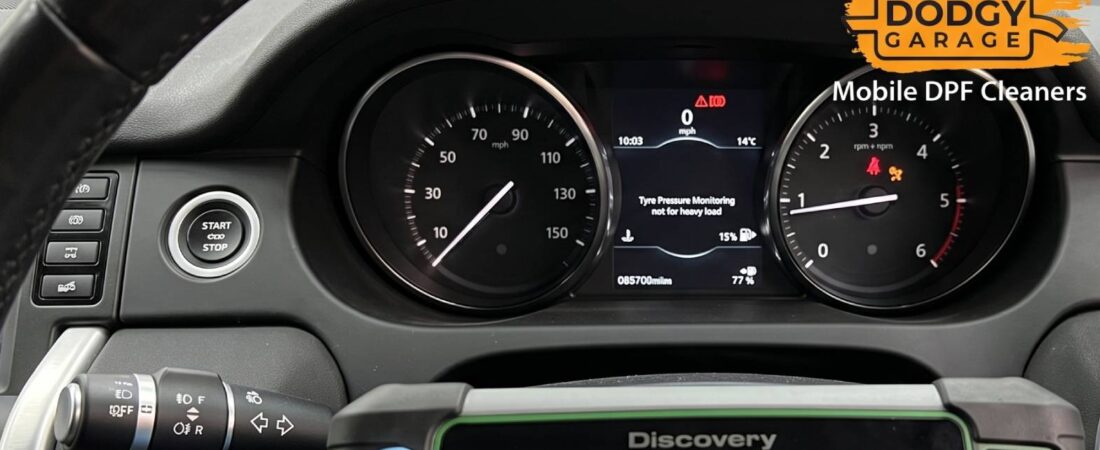
If you own a modern diesel Land Rover, seeing the “Exhaust Filter Full – Visit Dealer” message on your dashboard, usually accompanied by a glowing engine management light, is a sinking feeling. It means your Diesel Particulate Filter (DPF) is heavily blocked, and the vehicle can no longer regenerate itself.
Recently, at Dodgy Garage, we were called out to look at a Land Rover Discovery Sport presenting exactly this issue. Here is a breakdown of how we diagnosed the problem, performed a mobile DPF clean, and got the vehicle running back within factory specs—potentially saving the customer thousands on a replacement filter.
Step 1: Diagnosing the Fault Codes
When you are faced with a blocked DPF, throwing chemicals at it blindly is a bad idea. We always start by plugging our OBD scanner into the vehicle to read the Power Control Module (PCM).
On this Discovery Sport, we pulled 9 fault codes, but only one was marked as permanent and relevant to our issue: Code P2463 – Diesel Particulate Filter Restriction – Soot Accumulation.
This code shows that soot chokes the DPF physically.
Step 2: Analysing the Live Data
Next, we look at the live data to see exactly how badly the system is struggling.
- Soot Load: The ECU calculated the soot load at a staggering 103%.
- Differential Pressure: At idle, the pressure was around 60 millibars. When revved to around 2,500 RPM, it shot up to 230 millibars (23 kPa). To put that in perspective, a healthy DPF should read under 10 millibars at idle, and ideally between 40 and 80 millibars when revved.
- Temperature Sensors: We also check the exhaust gas temperature sensors. The ECU relies on these sensors to know when the exhaust is hot enough to perform a regeneration. If a sensor is dead (as Sensor 2 was in our case), it will prevent regen.
- Coolant Temperature: We monitor the coolant temperature to ensure the thermostat is functioning correctly. If a car runs cold, it will never initiate a DPF regeneration.
Step 3: Inspecting for a Cracked DPF
A quick wipe of the exhaust tailpipe revealed black soot. This is a telltale sign that the ceramic core of the DPF has a slight crack, allowing some soot to bypass the filter.
While a cracked DPF isn’t ideal, it’s not always an immediate death sentence. If the vehicle lacks a downstream Particulate Matter Sensor (which this specific model did not), a cracked DPF can usually be cleaned by the technician. A slightly cracked filter can still trap 95% of the soot, keeping the vehicle running well for time before replacement.
Step 4: The Mobile Chemical Clean
With the diagnostics complete, we move on to the cleaning phase:
- Access: We gain access to the DPF by removing the AdBlue injector located on the exhaust system.
- Injection: We inject our specialised DPF cleaning chemicals directly into the filter through the injector port.
- Soak: We let the chemicals sit for 30 minutes to break down the hardened soot and ash.
- Burn Off: We start the vehicle and hold the RPMs at around 2,500 to 3,000. This forces the broken-down soot out of the exhaust as steam and smoke.
During the burn-off, we watch the live data closely. We saw the pressure drop significantly, but it was still reading slightly higher than we’d like.
Step 5: The Crucial Scanner Reset
Here is a crucial trick for Land Rovers. Even when the DPF is physically clean, the ECU often “remembers” the old, high-pressure readings.
To fix this, you must use your diagnostic scanner to perform a specific service function.
- Navigate to Special Functions > Powertrain.
- Select Diesel Particulate Filter Replacement.
- Follow the scanner’s prompts exactly (which usually involves turning the ignition on and off several times).
By telling the vehicle it has a “new” DPF, you force the ECU to recalculate the pressure readings from scratch. After performing this reset, our live data showed a massive improvement. At 3,000 RPM, the differential pressure had dropped from 230 millibars all the way down to 70 millibars (7 kPa)—well within the healthy factory specifications!
Finally, we erased the fault codes, and the engine management light and “Exhaust Filter Full” warning disappeared.
Need a DPF Clean?
If your diesel vehicle remains in limp mode or displays DPF warnings, wait before purchasing a replacement. Proper live data diagnostics and a professional chemical clean can often save the day.
Check out the full diagnostic process on our YouTube Channel, and if you are in the Weston-super-Mare area, get in touch with Dodgy Garage for mobile DPF cleaning!