
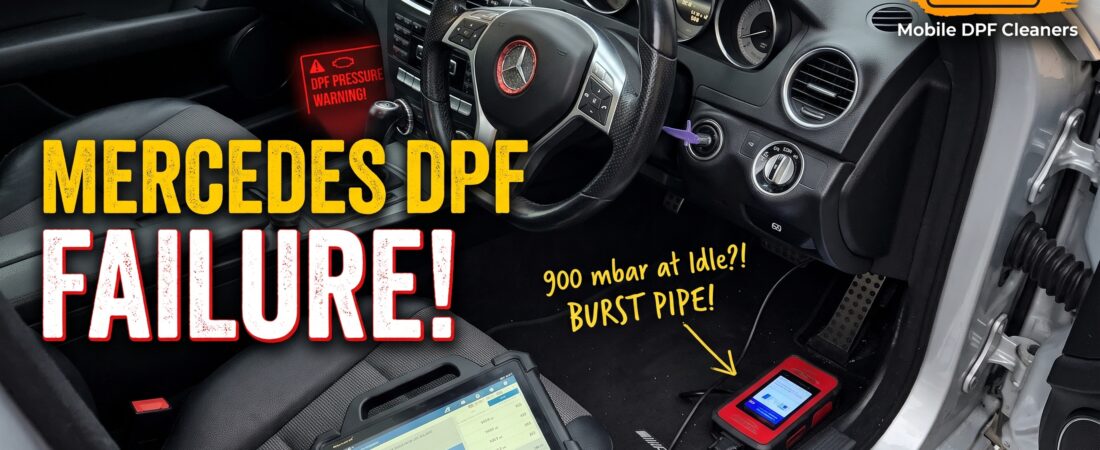
When a customer reports a DPF (Diesel Particulate Filter) warning light glowing on the dashboard of their 2012 Mercedes C220, it requires immediate attention. Ignoring DPF warnings can lead to severe engine performance degradation, limp mode, and costly replacements.
At Dodgy Garage, our mobile diagnostic and DPF cleaning service brings the garage to your driveway across Bridgwater and Somerset. In our latest service call, what started as a standard DPF fault code hunt quickly revealed a dual-layered mechanical failure.
Reading the Live Data: The Differential Pressure Sensor
The first step in any modern vehicle diagnostic is hooking up the code reader. On the 2012 Mercedes C 220, the OBD2 port is conveniently located behind a small access door underneath the driver’s side dashboard.
After dialling into the car’s system, the initial fault codes pointed directly to the diesel differential pressure sensor:
- Fault 1: Input for the differential pressure sensor has a short circuit to ground (Current and Stored).
- Fault 2: Diesel differential pressure sensor registers pressure that is too high.
To confirm the computer’s diagnosis, we fired up the ignition and navigated to the live data stream for the diesel particulate filter. The live readings showed the differential pressure sensor sitting at 0.9 bar (900 millibars/hPa).
To put that into perspective, a healthy DPF should read between 0 and 10 millibars at idle. A reading of 900 millibars at a standstill is a mathematical impossibility for exhaust flow, confirming that the sensor itself had completely failed and required replacing.
The Visual Inspection: Finding the Hidden Culprit
Relying solely on digital diagnostics is a rookie mistake. A thorough visual inspection of the engine bay is always necessary. By removing the motor cover and inspecting the lower components, we spotted a secondary, highly common issue on these Mercedes engines: a burst red boost pipe.
A split boost pipe causes massive drops in turbo pressure, leading to an over-fuelling situation. This excess unburnt diesel creates heavy soot, which prematurely clogs the DPF and exacerbates the back-pressure issues that the sensors monitor.
The Repair Plan
Because mobile mechanics operate out of specialized vans, we don’t carry every proprietary manufacturer hose on hand. With the diagnostics complete, the repair roadmap for this Mercedes C220 was set:
- Order OEM Parts: Source a replacement red boost pipe and a new DPF differential pressure sensor.
- Clear the Access Path: The DPF pressure sensor on this engine is tucked away at the back of the block. Replacing it requires the careful removal of the airbox and the ECU to gain proper access.
- Install and Recalibrate: Fit the new components, clear the stored fault codes, and monitor the live data stream to ensure the idle pressure returns to a healthy 0-10 millibars.
If your vehicle is suffering from sluggish performance, engine management lights, or DPF warnings in the Somerset area, don’t wait for a minor sensor fault to become a major exhaust blockage.
Frequently Asked Questions
Can a split boost pipe cause a DPF warning light?
Yes. A burst or split boost pipe causes a loss of turbo pressure, which leads the engine to over-fuel. This excess unburnt diesel creates heavy soot that rapidly clogs the Diesel Particulate Filter (DPF) and triggers the dashboard warning light.
What should the DPF differential pressure sensor read at idle?
On a healthy Mercedes C220, the DPF differential pressure sensor should read between 0 and 10 millibars at idle. Readings significantly higher than this (such as 900 millibars) indicate a severe blockage or a completely failed sensor.
Can I drive my Mercedes C220 with a DPF warning light on?
It is highly recommended not to ignore a DPF warning. Continuing to drive can force the vehicle into ‘limp mode,’ severely restrict engine performance, and potentially cause irreversible damage to the exhaust system. You should arrange a mobile diagnostic scan in the Somerset area immediately.